
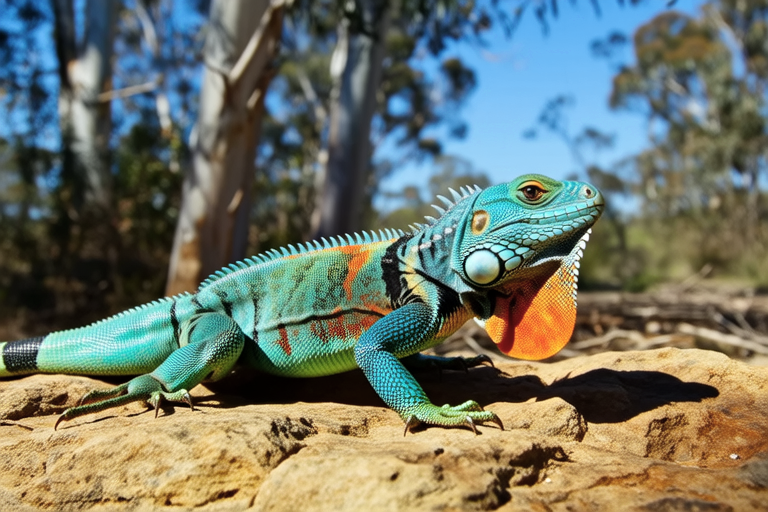
This Lizard is More Colorful Than a Rainbow: Why Everyone’s Obsessed with the Splendid Japalure
Imagine a creature so dazzling it looks like a living prism—its scales shimmering in hues that shift from electric blue to fiery magenta, from emerald green to deep violet, all under the sunlight. You’d think you were staring at a piece of abstract art, not a real animal. But this isn’t fantasy—it’s the **Splendid Japalure** (*Japalura splendida*), a tiny lizard from the lush jungles of New Guinea that’s turning heads and stealing hearts across the world.
If you’ve ever seen one of these lizards up close—especially when they’re basking in sunlight or performing their mesmerizing courtship displays—you’ll understand why reptile lovers everywhere are calling it “the rainbow lizard.” It’s not just beautiful; it’s a masterpiece of nature’s engineering, packed with secrets about light, evolution, and survival. And now, more than ever, people are falling head over heels for this iridescent marvel.
### The Science Behind the Sparkle: Nature’s Living Kaleidoscope
So, how does this little lizard manage to look like it’s made of stained glass? The answer lies not in pigment—but in **structure**.
Unlike most animals whose colors come from chemicals (like melanin or carotenoids), the Splendid Japalure gets its dazzling hues through **structural coloration**. This means its skin contains microscopic structures—tiny ridges, layers, and air pockets—that bend and reflect light in specific ways. Think of it like a natural optical illusion.
When sunlight hits the lizard’s scales, these nanostructures cause **light refraction and interference**, splitting white light into its individual wavelengths and bouncing them back in vibrant, shifting patterns. The result? A kaleidoscopic display that changes depending on your viewing angle and the intensity of light. One second it’s a cool sapphire blue; the next, it’s blazing crimson. It’s like wearing a suit that changes color with every step.
This kind of coloration is rare in the animal kingdom and usually found in birds (like peacocks) or butterflies. Finding it in a lizard makes the Splendid Japalure even more extraordinary—and scientifically fascinating.
### Home in the Clouds: New Guinea’s Hidden Paradise
The Splendid Japalure calls the misty, mountainous rainforests of **New Guinea** home. That’s the island shared by Papua New Guinea and Indonesia, a place where biodiversity explodes in every direction. These lizards live high in the canopy, often perched on tree trunks, vines, or moss-covered branches, tucked away in humid, shaded forests where sunlight filters through in golden shafts.
They thrive in areas with consistent moisture and moderate temperatures—perfect conditions for a creature that relies on humidity to stay healthy. Their habitat is rich with insects, fungi, and leaf litter, providing both food and cover. Because they’re so elusive and live in remote regions, scientists still don’t know everything about their population dynamics or long-term behaviors.
But what we do know is this: the Splendid Japalure is a master of disguise when it needs to be. While its daytime appearance is a flamboyant showstopper, it can subtly dull its colors when threatened—blending into shadows or bark to avoid predators like birds or snakes. It’s nature’s ultimate balance between beauty and survival.
### Size, Style, and Survival Skills
Despite its bold appearance, the Splendid Japalure is relatively small—typically measuring about **6 to 8 inches long**, including its tail. That’s about the size of a large pencil. Its body is slender and agile, built for life among branches and vines. It has strong, slightly sticky toes perfect for gripping smooth surfaces, and a long, prehensile tail that helps it balance as it navigates tight spaces.
One of its most striking features? The **flaps of skin along its sides and neck**, which resemble delicate wings. When the lizard feels threatened or during courtship, it can expand these flaps dramatically—creating a sudden, wide silhouette that startles predators or impresses mates. It’s like nature’s version of a superhero cape!
These lizards are also known for their **active, curious personalities**. They move with purpose—darting, pausing, scanning their surroundings with bright, intelligent eyes. They’re not aggressive, but they’re alert and quick-witted. In captivity, many develop trust with their keepers, even following them around their enclosure with keen interest.
### Diet and Daily Life: What Does a Rainbow Lizard Eat?
In the wild, the Splendid Japalure is an insectivore, feasting on small bugs like ants, beetles, crickets, and spiders. It hunts by sight, using its sharp vision to spot prey amid the foliage. It’s a patient hunter, waiting quietly until the right moment to strike—then darting forward with surprising speed.
In captivity, they thrive on a varied diet of gut-loaded crickets, mealworms, and roaches—supplemented occasionally with fruit flies or small waxworms for variety. A balanced diet is crucial for maintaining their vibrant colors. Poor nutrition can lead to dull, faded scales—a sad contrast to their natural brilliance.
They’re also sensitive to environmental changes. Too dry, too hot, or too noisy, and they may become stressed, stop eating, or hide constantly. That’s why responsible care is essential.
### Why Are People So Obsessed? The Rise of the Pet Phenomenon
In recent years, the Splendid Japalure has skyrocketed in popularity among reptile hobbyists—not just for its looks, but for its unique charm. Unlike larger, more intimidating lizards like iguanas or monitors, the Splendid Japalure is compact, quiet, and surprisingly interactive. Many owners report that their lizards seem to recognize them, respond to their voice, and even enjoy being observed.
Social media has played a huge role in spreading the word. Videos of these lizards basking in sunlight, expanding their flank flaps, or doing slow-motion acrobatics on branches go viral within hours. People aren’t just impressed—they’re inspired. “I’ve never seen anything like it,” one owner said. “It’s like watching a living jewel.”
But here’s the catch: **this surge in popularity comes with responsibility**.
### Caring for Your Rainbow Companion: What You Need to Know
If you’re considering bringing a Splendid Japalure into your home, prepare yourself for a rewarding—but demanding—experience. These lizards aren’t low-maintenance pets. Here’s what you need:
– **Enclosure**: A well-ventilated terrarium (at least 18” x 18” x 18”) with plenty of vertical space for climbing. Include branches, vines, and live plants to mimic their natural environment.
– **Humidity & Temperature**: Maintain 70–80% humidity and a temperature gradient between 75°F and 85°F (24°C–29°C). Use a hygrometer and thermometer to monitor conditions.
– **Lighting**: Full-spectrum UVB lighting is essential. It helps them metabolize calcium and maintain their health and color vibrancy.
– **Feeding Schedule**: Offer small insects every other day, dusted with calcium and vitamin supplements. Remove uneaten prey promptly to prevent stress or injury.
– **Handling**: Minimal handling is best. These lizards are not cuddly—they’re delicate and easily stressed. Observe, admire, and let them be.
And remember: **never buy from unregulated sources**. Wild-caught specimens are illegal to trade internationally under CITES (the Convention on International Trade in Endangered Species), and their capture harms ecosystems and populations.
### Debunking Myths: What You Shouldn’t Believe About the Splendid Japalure
Let’s clear up some common misconceptions:
❌ *“They’re easy to care for because they’re small.”*
Not true. Their small size doesn’t mean lower needs. In fact, their sensitivity to micro-environmental changes makes them more challenging than many larger lizards.
❌ *“They’ll thrive in any setup.”*
Wrong again. They require specific humidity, temperature, and lighting conditions. Without them, they can suffer from dehydration, metabolic bone disease, or stress-related illnesses.
❌ *“They’re aggressive and hard to bond with.”*
Actually, many Splendid Japalures form strong bonds with attentive, respectful keepers. They’re shy, yes—but not hostile. With patience and consistency, they can become trusted companions.
### Conservation: Love It, But Don’t Exploit It
Here’s the truth no one wants to hear: **the Splendid Japalure is vulnerable**. While not currently listed as endangered by the IUCN, its population is poorly studied, and habitat loss due to logging and agriculture threatens its future. Plus, the demand for exotic pets fuels illegal wildlife trafficking—often with devastating consequences.
Every time someone buys a wild-caught lizard, they contribute to a cycle that endangers entire ecosystems. Even if a breeder claims to be “ethical,” without proper oversight, breeding programs can collapse or fail to meet standards.
That’s why **responsible ownership starts with sourcing**. Always choose captive-bred individuals from reputable breeders who prioritize animal welfare and sustainability. Ask for documentation, visit facilities if possible, and support organizations working to protect New Guinean rainforests.
### A Call to Admire, Respect, and Protect
The Splendid Japalure isn’t just a pet—it’s a symbol. A symbol of nature’s boundless creativity, of the delicate balance between beauty and survival, and of our responsibility to protect the planet’s hidden wonders.
You don’t have to own one to appreciate it. Simply learning about it, sharing its story, and supporting conservation efforts makes a difference. Watch videos, read books, visit zoos with ethical reptile exhibits, or donate to rainforest preservation groups. Every action counts.
And if you do decide to bring one home? Do it with love, respect, and knowledge. Treat it not as a trophy, but as a guest from another world—one that reminds us how breathtaking life truly can be.
So next time you see a flash of iridescent blue in a photo or video, pause. Take a breath. Let that moment sink in. That’s not just a lizard. That’s a living rainbow. A miracle woven from light, evolution, and wonder.
And perhaps, just perhaps, it’s a reminder to cherish the extraordinary—even the smallest, most colorful creatures—before they vanish from the world we share.
—
Stay curious. Stay kind. And always, always look closer.