
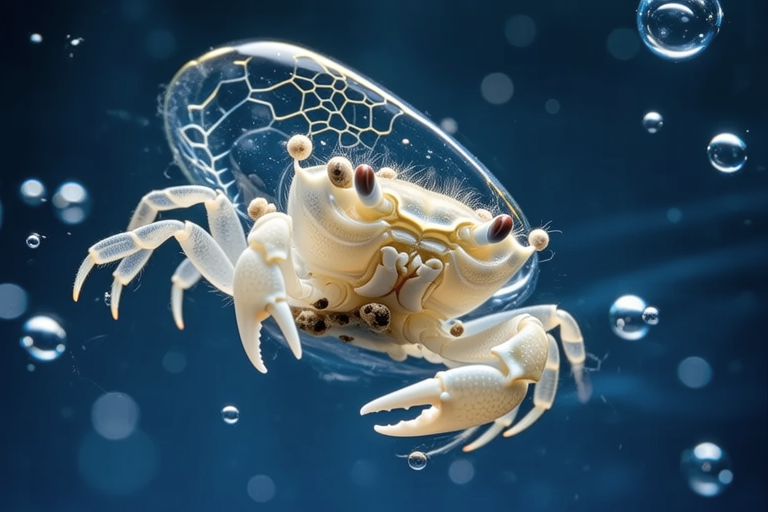
The Fascinating World of Pea Crabs: Microscopic Marvels Revealed
Welcome to the enchanting world of pea crabs, a group of crustaceans that have captivated scientists and nature enthusiasts alike. These tiny creatures, named for their resemblance to peas, are among the smallest true crabs in existence. Despite their diminutive size, pea crabs play a crucial role in marine ecosystems, offering a glimpse into the intricate web of life beneath the waves.
Introduction to Pea Crabs
Pea crabs, belonging to the superfamily Pinnotheroidea, are found worldwide in coastal waters, from shallow bays to deep ocean trenches. They typically reside within the bodies of larger marine organisms such as mussels, barnacles, sea cucumbers, and even some species of echinoderms. The average size of a pea crab is less than 1 cm, making them one of the smallest true crabs on Earth. Their microscopic stature allows them to thrive in the confined spaces of their hosts, where they are protected from predators and environmental stressors.
Anatomy and Evolutionary Adaptations
The anatomy of pea crabs is highly specialized for their parasitic lifestyle. They possess flattened bodies, which enable them to maneuver through the narrow spaces within their hosts. Their legs are adapted for gripping onto the internal tissues of their hosts, ensuring they remain securely in place. Unlike many other crab species, pea crabs lack the ability to swim freely, relying instead on the movement of their hosts for transportation. This evolutionary adaptation has allowed them to survive in environments where swimming would be inefficient or impossible.
One of the most fascinating aspects of pea crabs is their reproductive strategy. Male and female pea crabs often live together within the same host, creating a monogamous relationship that ensures the protection and care of offspring. Females carry their eggs on their abdomen until they hatch, after which the larvae disperse into the water column to find new hosts. This method of reproduction is highly efficient, given the limited space available within the host organism.
Symbiotic Relationships
The symbiotic relationships between pea crabs and their hosts are complex and mutually beneficial. While pea crabs rely on their hosts for protection and nutrients, they also provide certain benefits in return. For instance, some studies suggest that pea crabs may assist in the cleaning process of their hosts, helping to remove debris and parasites that could otherwise cause harm. Additionally, the presence of pea crabs can influence the behavior of their hosts, potentially enhancing their survival chances.
In the case of mussels, pea crabs live inside the mantle cavity, feeding on plankton and detritus filtered by the mussel. This arrangement benefits both parties: the pea crab receives a constant food supply, while the mussel gains protection from certain predators that avoid attacking hosts known to harbor pea crabs. Similarly, pea crabs living within barnacles benefit from the protection offered by the hard exoskeleton of the barnacle, while also contributing to the overall health of the host.
Recent Scientific Discoveries
Recent scientific studies have shed light on the genetic diversity and evolutionary history of pea crabs. Researchers have identified several distinct species within the genus Pinnotheres, each adapted to specific host organisms. Genetic analyses have revealed that pea crabs have evolved alongside their hosts over millions of years, developing unique adaptations to thrive in their respective environments.
A groundbreaking study published in 2020 examined the impact of climate change on pea crab populations. The research found that rising sea temperatures and ocean acidification are affecting the availability of suitable hosts for pea crabs, leading to changes in their distribution patterns. As global temperatures continue to rise, understanding how pea crabs will adapt to these environmental shifts becomes increasingly important for predicting the future of marine ecosystems.
The Importance of Studying Pea Crabs
Studying pea crabs is essential for gaining a deeper understanding of marine ecosystems. These tiny creatures serve as indicators of the overall health of their hosts and the broader environment. By monitoring pea crab populations, researchers can gain insights into the prevalence of certain diseases, the abundance of potential hosts, and the effects of environmental changes on marine biodiversity.
Furthermore, the study of pea crabs provides valuable information about the evolution of parasitism and symbiosis. Understanding how these small organisms have adapted to their hosts over time can offer clues about the development of similar relationships in other species. This knowledge can be applied to fields such as medicine, where parasitic relationships between microorganisms and humans are studied to develop new treatments for diseases.
As we continue to explore the depths of our oceans, it is crucial to recognize the importance of every organism, no matter how small. Pea crabs, with their unique adaptations and vital roles within marine ecosystems, remind us of the complexity and interconnectedness of life beneath the waves. By dedicating time and resources to the study of these microscopic marvels, we can uncover new secrets about the world around us and work towards preserving the delicate balance of marine life.
In conclusion, the fascinating world of pea crabs offers a window into the hidden lives of marine organisms and the intricate relationships that define our planet’s ecosystems. From their tiny size and specialized anatomy to their symbiotic relationships with hosts and contributions to scientific discovery, pea crabs are more than just a curiosity – they are a key component of the marine environment. By continuing to study these remarkable creatures, we can deepen our understanding of the natural world and work towards protecting it for future generations.