
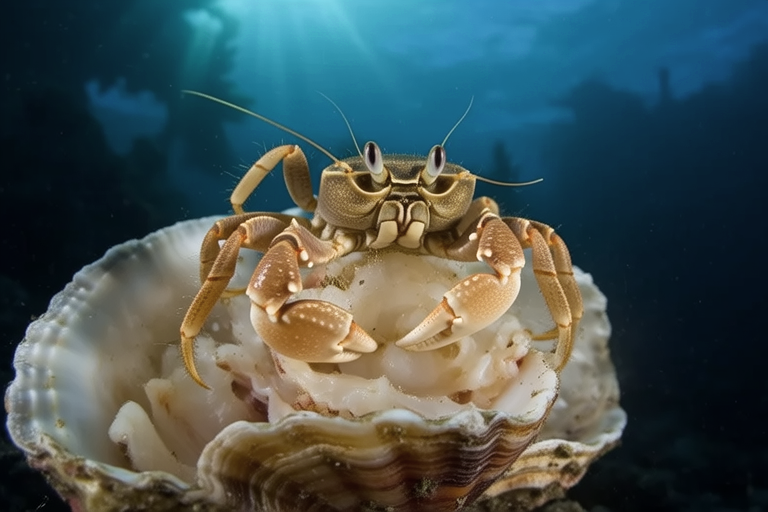
The Symbiotic Relationship Between Pea Crabs and Clams
The ocean is teeming with countless forms of life, each playing a crucial role in maintaining the delicate balance of marine ecosystems. One such remarkable partnership exists between pea crabs (Pinnotheridae) and clams. These tiny crustaceans have developed a unique living arrangement within various clam species, creating a symbiotic relationship that benefits both parties. This article delves into the intricate details of this relationship, highlighting the adaptations, benefits, ecological significance, and challenges faced by pea crabs and their clam hosts.
Introduction to Pea Crabs and Their Hosts
Pea crabs, belonging to the family Pinnotheridae, are small, soft-bodied crustaceans named for their resemblance to garden peas. They inhabit the mantle cavity of various bivalve mollusks, including scallops, oysters, and most notably, clams. The term “pea crab” is somewhat misleading as it encompasses a diverse group of species, each adapted to different host species. Some common pea crab genera include Pinnixa, Portlandia, and Pinnotheres.
Clams, members of the class Bivalvia, are characterized by their two-part hinged shell and filter-feeding habits. They are found in a wide range of aquatic environments, from shallow coastal waters to deep-sea habitats. Clam species hosting pea crabs include Geukensia demissa (ribbed mussel), Mercenaria mercenaria (hard clam), and Venerupis philippinarum (Manila clam). The choice of host is often influenced by factors such as availability, compatibility, and environmental conditions.
Adaptations for Coexistence
The symbiotic relationship between pea crabs and clams is marked by several key adaptations that enable the crabs to thrive within their host’s mantle cavity. Pea crabs possess reduced chelae (claws) and flattened bodies, allowing them to navigate through the narrow spaces within the clam’s shell. Additionally, their exoskeletons are thin and flexible, enabling them to fit snugly against the clam’s gills without impeding respiration or feeding. In return, pea crabs provide some level of protection to their hosts by deterring potential predators and parasites.
Pea crabs have also developed specialized appendages for feeding, which they use to scavenge organic matter from the water flowing through the clam’s gills. This behavior supplements the clam’s diet, potentially enhancing nutrient absorption and overall health. Furthermore, pea crabs may assist in cleaning the clam’s respiratory surfaces, thereby improving oxygen uptake and reducing the risk of infections.
Benefits of the Symbiotic Relationship
The symbiotic relationship between pea crabs and clams offers numerous benefits to both parties. For pea crabs, the clam’s mantle cavity provides a protected environment where they can avoid predation while having access to a steady supply of food. The constant flow of water through the clam’s gills ensures a continuous influx of nutrients, allowing pea crabs to thrive without the need for extensive foraging outside their host.
For clams, the presence of pea crabs can offer several advantages. Firstly, pea crabs help maintain the cleanliness of the clam’s gills by removing debris and microorganisms. This reduces the risk of infections and improves respiratory efficiency. Secondly, pea crabs may act as a deterrent to potential predators, as their presence within the clam’s shell can make the host less appealing to would-be attackers. Finally, pea crabs contribute to the clam’s diet by scavenging organic matter from the water column, potentially enhancing the host’s growth and reproductive success.
Ecological Significance
The symbiotic relationship between pea crabs and clams plays a significant role in marine ecosystems. By facilitating nutrient transfer between different trophic levels, this partnership contributes to the overall productivity and stability of benthic communities. Pea crabs, as scavengers, play a vital role in breaking down organic matter, recycling nutrients, and maintaining the health of their host clams. This process ultimately benefits other organisms within the ecosystem, including fish, birds, and humans who rely on clams as a food source.
In addition to their direct ecological impacts, pea crabs and clams serve as indicators of environmental health. Changes in the abundance or distribution of these species can signal shifts in local conditions, such as pollution levels, temperature fluctuations, or habitat degradation. Monitoring these symbiotic relationships can provide valuable insights into the broader state of marine ecosystems and inform conservation efforts.
Challenges and Threats
Despite the many benefits of their symbiotic relationship, pea crabs and clams face several challenges and threats in their shared environment. Climate change, pollution, and overfishing pose significant risks to both partners, potentially disrupting their delicate balance. Rising sea temperatures and acidification can negatively affect clam growth and survival, while pollutants like heavy metals and pesticides may accumulate in the tissues of both pea crabs and clams, leading to health issues.
Predation remains another major threat to pea crabs, despite their protective living arrangement. Certain fish species, such as flatfish and rays, are known to prey on clams containing pea crabs. When attacked, the clam may close its shell tightly around the crab, providing a temporary refuge. However, prolonged exposure to predators can result in injury or death for both parties. To mitigate these risks, pea crabs have developed behavioral adaptations, such as remaining motionless when threatened or moving deeper within the clam’s mantle cavity.
Evolutionary Insights
The evolution of the symbiotic relationship between pea crabs and clams represents an intriguing example of coevolution, where both partners have adapted to one another over millions of years. Fossil evidence suggests that this partnership dates back at least 50 million years, with early pea crabs inhabiting the mantle cavities of ancient clam-like mollusks. Over time, both groups have undergone numerous changes in morphology, behavior, and physiology to optimize their mutualistic association.
Recent genetic studies have provided further insights into the evolutionary history of this relationship. By analyzing DNA sequences from pea crabs and their host clams, researchers have identified several instances of convergent evolution, where unrelated species independently develop similar traits to exploit the same ecological niche. These findings suggest that the symbiotic relationship between pea crabs and clams has arisen multiple times throughout evolutionary history, indicating its adaptive value in diverse marine environments.
New Findings and Research Directions
Advances in molecular biology and genomics have opened up new avenues for studying the symbiotic relationship between pea crabs and clams. Recent research has focused on understanding the chemical communication between partners, revealing that pea crabs release specific compounds that stimulate clam feeding and reproduction. These signals likely play a crucial role in maintaining the balance between the two species and ensuring the long-term viability of their symbiotic relationship.
Another area of active investigation concerns the impact of climate change on this partnership. As global temperatures continue to rise, scientists are examining how pea crabs and clams will adapt to changing environmental conditions. Initial studies suggest that both partners may experience shifts in distribution and abundance, with some populations expanding into previously unsuitable habitats while others decline due to increased stressors. Understanding these dynamics is essential for predicting future trends in marine biodiversity and informing conservation strategies.
Conclusion
The symbiotic relationship between pea crabs and clams exemplifies the complexity and beauty of marine ecosystems. Through their unique adaptations and mutual benefits, these tiny crustaceans and their bivalve hosts have formed a partnership that has endured for millions of years. As we continue to explore the intricacies of this relationship, new discoveries will undoubtedly emerge, shedding light on the mechanisms that underpin successful symbioses and offering valuable lessons for conservation and management efforts.