
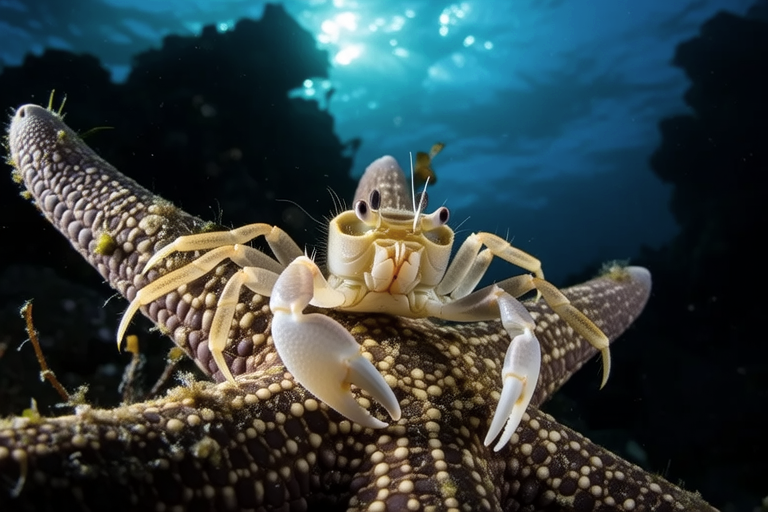
The Hidden World of Pea Crabs: A Symbiotic Journey
Deep within the vast ocean, there exists a fascinating world where tiny crustaceans called pea crabs live secret lives inside their marine hosts. These miniature creatures have adapted to live harmoniously with their hosts, forming a unique symbiotic relationship. This article delves into the intricate details of this partnership, exploring the benefits and challenges it presents, the ecological significance, and recent scientific discoveries.
A Secret Life Within Marine Hosts
Pea crabs, members of the family Pinnotheridae, are small, often transparent crustaceans that live within the bodies of various marine organisms, including bivalves, echinoderms, and even some fish. These hosts provide the crabs with protection from predators and a stable environment for growth and reproduction. In return, the crabs offer their hosts some form of benefit, creating a mutually beneficial relationship.
One of the most common hosts for pea crabs is the hard clam (Mercenaria mercenaria). The crabs reside within the clam’s mantle cavity, feeding on its tissues and mucus. Another notable host is the Pacific geoduck (Panopea generosa), a large burrowing clam. Pea crabs also inhabit sea cucumbers, such as Parastichopus californicus, and starfish, like the ochre star (Pisaster ochraceus). Fish, particularly gobies and blennies, can also serve as hosts for certain pea crab species.
The Benefits and Challenges of Symbiosis
For the pea crabs, the primary advantage of living within a host is protection from predators. Their small size and transparency make them vulnerable to larger marine animals. By residing inside their hosts, they avoid detection and reduce the risk of predation. Additionally, the crabs gain access to a constant food supply, as they feed on the host’s tissues and mucus. This ensures a steady source of nutrients, promoting their growth and survival.
However, living within a host also presents challenges for pea crabs. They must adapt to the internal environment of their host, which can vary significantly in temperature, salinity, and oxygen levels. Moreover, the crabs face competition for resources within the limited space of their host’s body. This competition can lead to conflicts over food and mating opportunities. Despite these challenges, pea crabs have developed unique adaptations that allow them to thrive in their concealed environments.
Unique Adaptations for Thriving in Concealed Environments
To survive within their hosts, pea crabs have evolved several remarkable adaptations. One of the most striking features is their small size, which allows them to fit comfortably within the confines of their host’s body. Some species can be as small as 3 millimeters in length, making them nearly invisible to potential threats. Additionally, many pea crabs have transparent exoskeletons, further aiding in camouflage and reducing the likelihood of detection.
Pea crabs also exhibit specialized feeding structures that enable them to extract nutrients from their hosts efficiently. For example, some species possess elongated mouthparts that can reach deep into the host’s tissues to obtain sustenance. Furthermore, the crabs have developed mechanisms to regulate their physiological processes, ensuring optimal functioning within the variable conditions of their host’s internal environment.
Ecological Significance of Pea Crab Symbiosis
The symbiotic relationship between pea crabs and their hosts plays a crucial role in marine ecosystems. It contributes to the stability and health of these environments by facilitating nutrient cycling and energy transfer between different trophic levels. Pea crabs act as decomposers, breaking down and recycling organic matter within their hosts. This process helps maintain the balance of nutrients in the surrounding waters, supporting the growth of other marine organisms.
Moreover, the presence of pea crabs within their hosts can influence the reproductive success and overall fitness of both partners. For instance, studies have shown that the presence of pea crabs in clams can enhance the clams’ ability to filter feed, leading to improved growth rates and increased reproductive output. Similarly, pea crabs can contribute to the reproduction of their hosts by stimulating the release of gametes or providing protection for developing offspring.
Recent Scientific Discoveries and Studies
Recent research has shed light on the complex nature of pea crab symbiosis and its implications for marine conservation. One study published in the journal Marine Biology investigated the effects of climate change on the symbiotic relationship between pea crabs and their hosts. The researchers found that rising water temperatures and ocean acidification can alter the physiology and behavior of both partners, potentially disrupting the delicate balance of their interaction.
Another study conducted by scientists at the University of California, Santa Barbara, explored the genetic diversity of pea crab populations within different host species. The findings revealed that pea crabs exhibit high levels of genetic variation, indicating that they may have the potential to adapt to changing environmental conditions. This resilience could be crucial for the long-term survival of these symbiotic relationships in the face of ongoing anthropogenic pressures.
The Importance of Understanding Symbiotic Relationships for Marine Conservation
Understanding the symbiotic relationship between pea crabs and their hosts is essential for effective marine conservation efforts. By studying these interactions, researchers can gain insights into the factors that influence the health and stability of marine ecosystems. This knowledge can inform the development of strategies to protect vulnerable species and promote the recovery of degraded habitats.
Conservation initiatives that focus on preserving the biodiversity of marine environments can help maintain the delicate balance of symbiotic relationships. Protecting key habitats, such as seagrass beds and coral reefs, provides refuge for pea crabs and their hosts, ensuring the continuation of these partnerships. Additionally, efforts to reduce pollution and mitigate the impacts of climate change can help safeguard the future of these symbiotic relationships and the ecosystems they support.
Conclusion
The symbiotic relationship between pea crabs and their marine hosts represents a fascinating example of adaptation and cooperation in the natural world. These tiny crustaceans have evolved to live harmoniously within their hosts, benefiting from the protection and resources they provide. While this partnership presents challenges for both parties, it also offers numerous advantages that contribute to the stability and health of marine ecosystems.
Ongoing research continues to uncover new insights into the complexities of pea crab symbiosis, highlighting the importance of understanding these relationships for marine conservation efforts. By protecting the biodiversity of marine environments, we can ensure the continued existence of these remarkable symbiotic partnerships and the vibrant ecosystems they support.